In southern Ethiopia, centuries-old agroforestry systems sustain food security, biodiversity and livelihoods on tiny plots.
This article follows a visit to the Humbo Carbon Project, where communities restored degraded land through collective action. In Gedeo, the journey revealed a different pathway — one shaped by centuries of agroforestry practice.
→ Read Part 1: How community-led forest restoration delivers climate and livelihoods
From Humbo, the group travelled to Gedeo Zone in the South Ethiopia Region to visit traditional agroforestry systems in Wonago District, where the Center for International Forestry Research and World Agroforestry (CIFOR-ICRAF) implements its Multifunctional Agroforestry for Enhanced Biodiversity, Improved Livelihoods and Resilient Landscapes in Ethiopian Highlands project with support from the Global Center on Biodiversity for Climate.
A landscape shaped by agroforestry
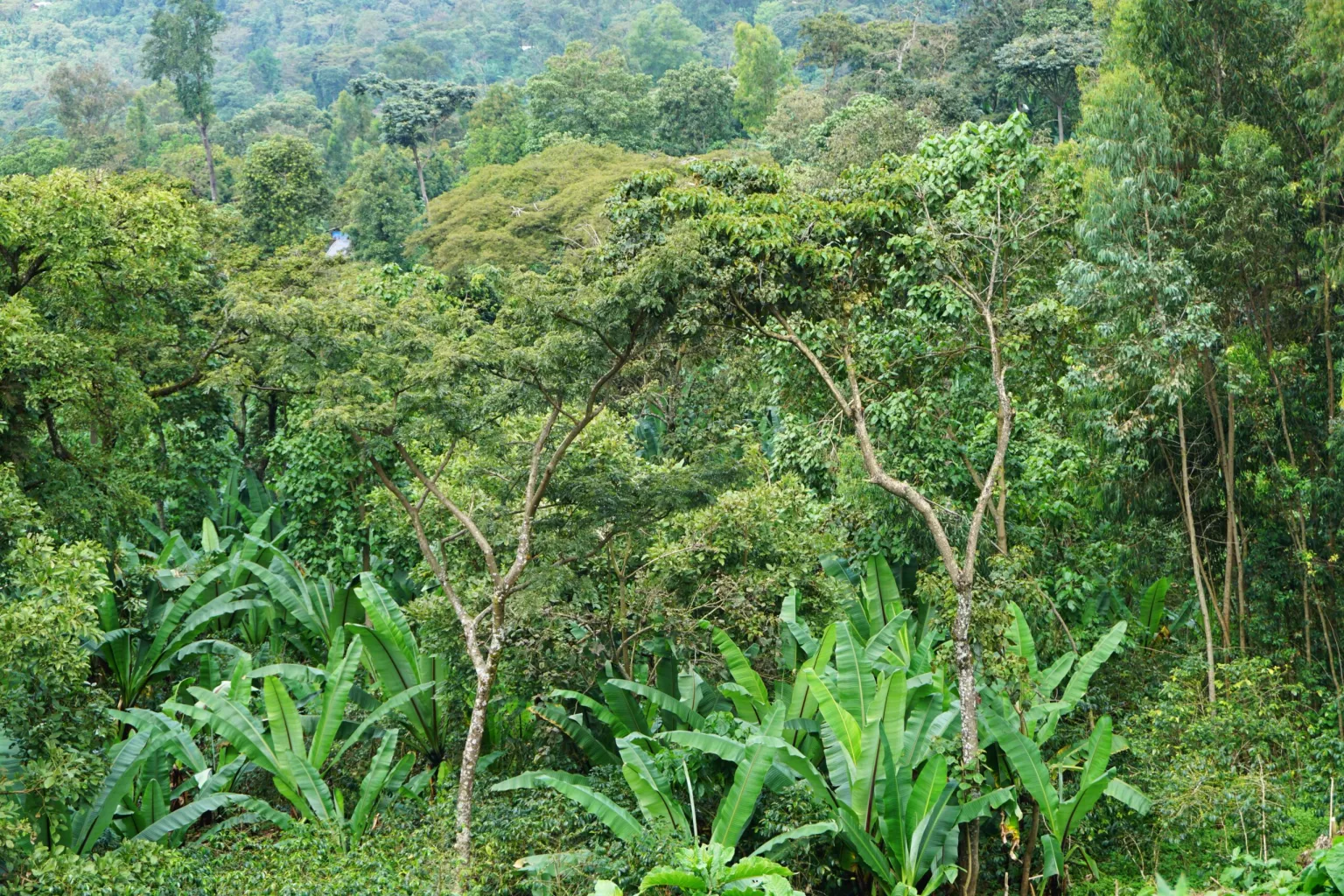
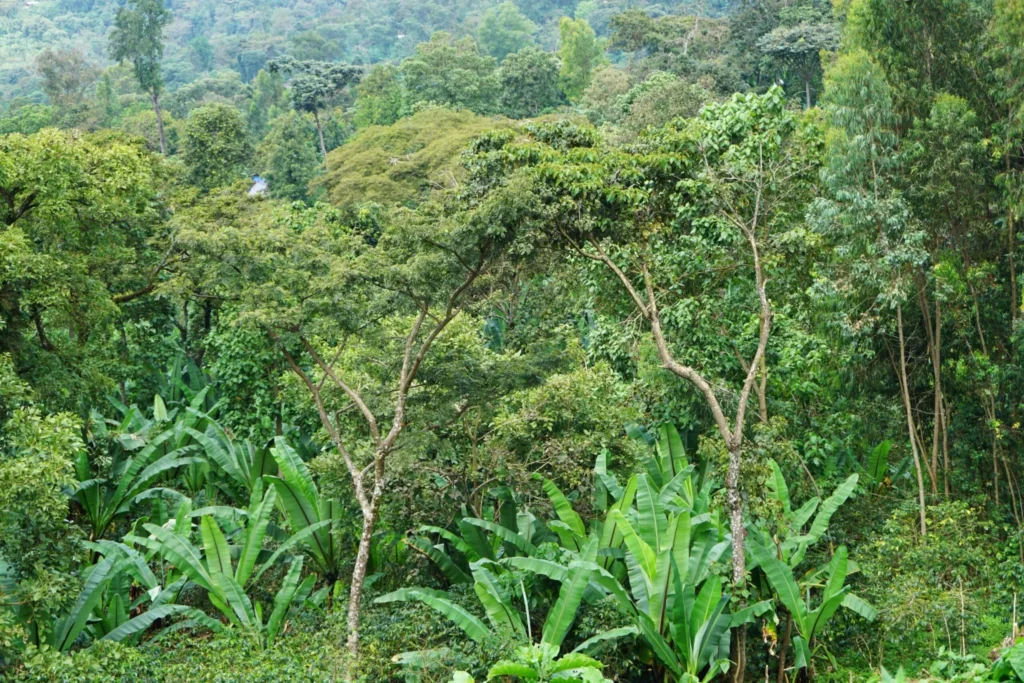
In Gedeo, visitors encountered a densely populated yet remarkably green landscape shaped by thousands of years of agroforestry. Farmers cultivate multilayered systems that integrate trees such as Cordia africana, Millettia ferruginea and Erythrina abyssinica with enset, coffee, root crops, beans and fruits including banana, pineapple and avocado.
Strict cultural norms govern tree use. Cutting a tree without planting another is taboo. “The Gedeo carry a machete, not an axe,” said Tsegazeab Zegeye, senior climate resilience programme advisor at Norwegian Church Aid. “They cut or pollard only branches when they need fuelwood. They rarely fell trees.”
Multi-stakeholder innovation platform established in South Ethiopia
Everyday rural livelihoods reflecting the land and population pressures that shape food security in many parts of Ethiopia.
Photo by Olivier Girard / CIFOR-ICRAF
Food security under population pressure
Despite extreme population density and landholdings averaging just a quarter of a hectare, the Gedeo landscape remains productive and food secure without external assistance. This contrasts sharply with many parts of northern Ethiopia, where population pressure has driven deforestation, land degradation and food insecurity.
In Gedeo, farmers intensify production through diversity rather than expansion. A single enset plant can feed a family for up to two months, while multiple crops and shade trees are integrated even on very small plots.
Integrating coffee and enset
On some farms, visitors observed coffee and enset planted in parallel lines, part of an “improved cluster agroforestry development” approach promoted by the regional government. Under this initiative, farmers are encouraged to grow at least 100 coffee trees.
Coffee provides a critical source of income as a strategic export crop, while enset offers food security and drought tolerance, as well as shade for coffee.

Youth, innovation and scaling up
The group also visited the Rural Resource Center established in 2024 through the CIFOR-ICRAF project. In its first year, youth managing the centre produced and sold improved avocado seedlings, earning 27,000 birr.
“Gedeo agroforestry has given me hope,” said Dr Getachew. “It shows that it is never too late to practise agroforestry elsewhere, as long as it is adapted to different agroecological zones.”
He emphasized that change requires demonstration rather than short-term campaigns. “Model farmers need to show others that this system works. Change may be slower, but it will be tangible.”
How green jobs are transforming rural Ethiopia
Lessons beyond Gedeo
Zeriye Ayele, from the Ethiopian Orthodox Church Development and Inter-Church Aid Commission, grew up in Jimma Zone, where coffee is widely grown under large shade trees. He said the Gedeo system could address land degradation and food insecurity in other high-rainfall regions.
“Agroforestry is not the people’s tradition in Jimma,” he said. “Farmers there grow coffee almost exclusively. Here, coffee is grown alongside enset and food crops, creating a healthier ecosystem even on a small plot.”
Acknowledgments
The visit to the South Ethiopia Region was supported and organized by CIFOR-ICRAF, Norwegian Church Aid and the Global Center on Biodiversity for Climate. Additional thanks go to World Vision, the Hobicha Bada Woyito Mountain Forest Development Cooperative and the Wonago District Agriculture Office. Appreciation is also extended to the farmers who welcomed visitors to their farms and the youth working at the Rural Resource Center in Wonago District.
More for you
Leave a Reply